Intelligent Energy Management
Introduction :
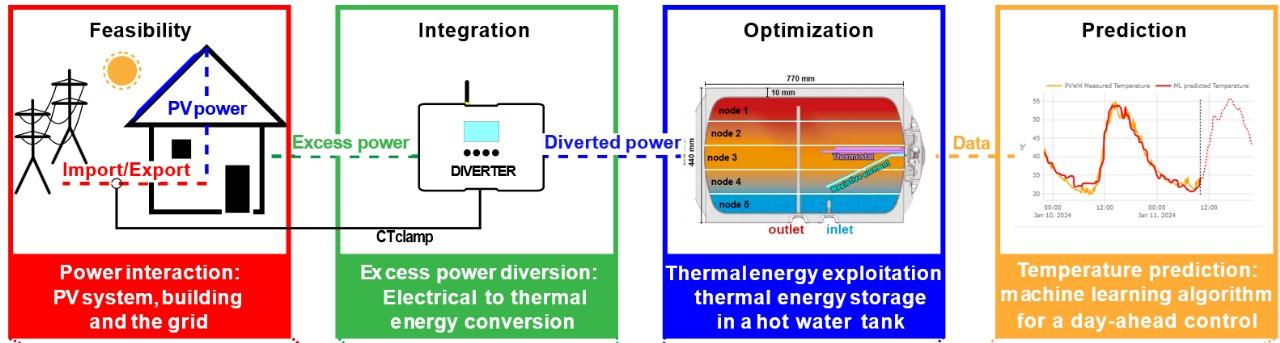
This study provides concrete solutions for prosumers (producer & consumer) wishing to optimise the integration of their photovoltaic system on the roof. Contributions include a technical-economic feasibility assessment of the thermal energy storage, a multi-objective optimisation approach for this integration, and the development of a predictive control strategy based on machine learning.
Problem Statement and Objectives :
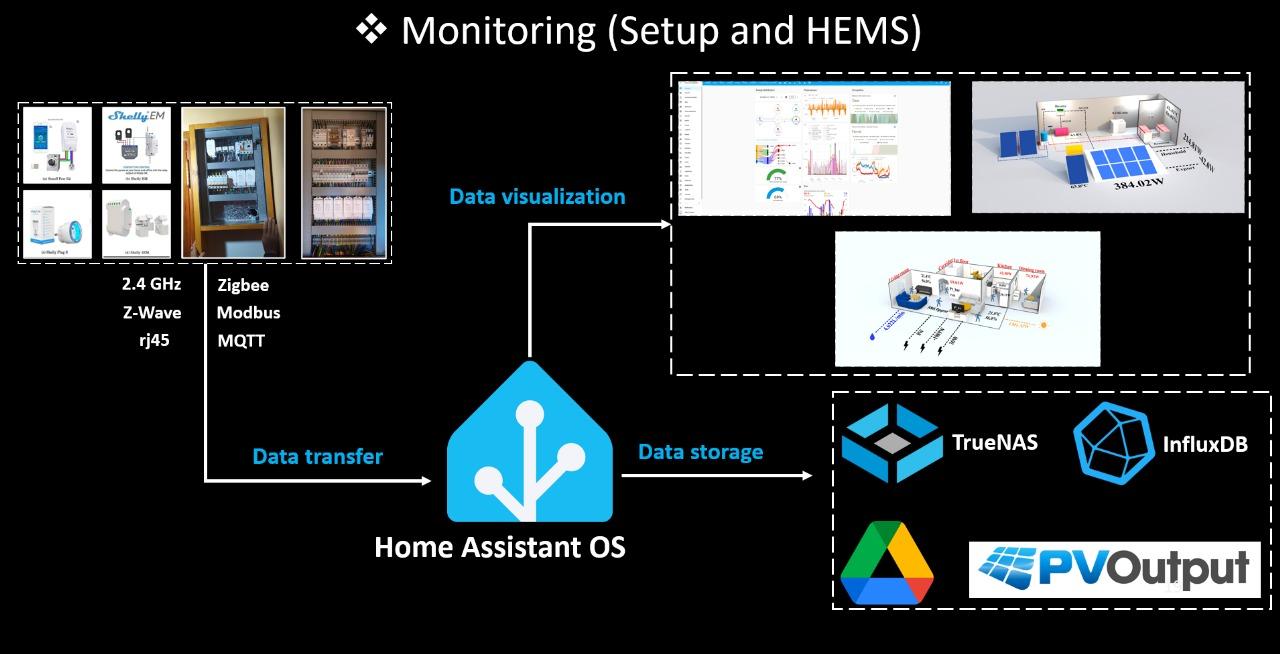
The research addresses the issue of excess photovoltaic (PV) energy export to the grid, a common problem for grid-connected residential PV systems, particularly in contexts like Morocco where vers le réseau, un problème courant pour les systèmes PV résidentiels connectés au réseau, en particulier dans des contextes comme le Maroc où les feed-in tariffs are non-competitive or non-existent. The main objective of this research is to assess the technical-economic feasibility and optimise the use of this excess energy PV for water heating in a storage tank, via a solar diverter, as the main system for hot water production for a bioclimatic building.
Methodology :
The study used a 2 kW grid-connected photovoltaic system, with excess energy data monitored for a year at a one-minute resolution. This data was integrated into a TRNSYS numerical simulation for Marrakech, Morocco. The research compared three water heater configurations: an electric water heater (ELWH - reference model), a photovoltaic water heater (PVWH), and a solar thermal water heater (STWH).
In parallel with the techno-economic analysis, an adaptive energy management framework based on machine learning, using the KNN algorithm, was developed for temperature prediction. This system collects temperature data at 5-minute intervals and dynamically adjusts to weather variations.
Key Results :
Techno-Economic
Feasibility
The photovoltaic water heater (PVWH) showed a significant improvement in the self-consumption rate of 52.23%. The levelised cost of energy (LCoE) for the PVWH was 0.06 USD/kWh, which is 33% lower than that of a typical solar thermal water heater (STWH) (0.09 USD/kWh). Furthermore, the PVWH had a shorter payback period (4 years) and a higher net present value (NPV) (1840.28 USD) compared to the STWH (1008.8 USD). These results highlight the efficiency and sustainability of PVWH systems optimised for domestic applications.
Multi-Objective Optimisation
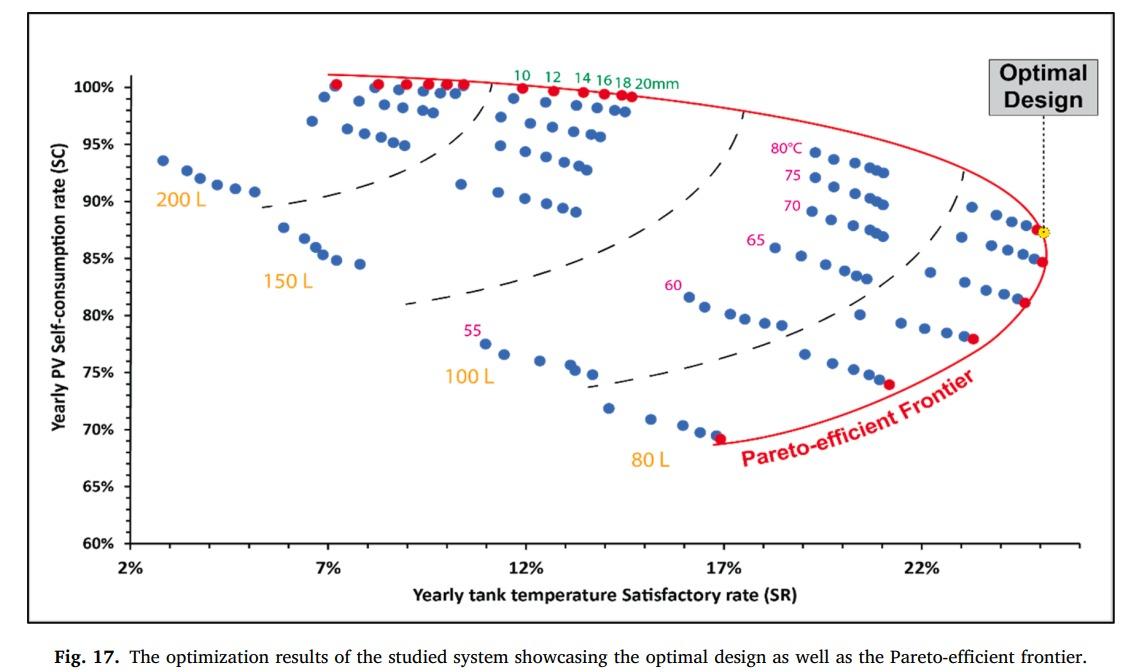
Thanks to multi-objective optimisation techniques, the research has revealed the possibility of achieving a high self-consumption rate of 87% and a supply of 2190 hours of hot water above 55°C. The optimised system also led to reductions of 46 % in auxiliary energy needs, 20% in energy losses, and a decrease of 0.175 tonnes in annual carbon emissions.
Predictive Control by Machine Learning
The energy management framework based on Machine Learning has demonstrated high predictive accuracy, with a coefficient of determination R² of 91% for water heating and 68% for space heating. This approach represents a major advance in the smart management of domestic energy by optimising the performance of thermal energy systems.
Publications and references
DRAOU Mohcine, BRAKEZ, Abderrahim & BENNOUNA Amin. "Techno-economic feasibility assessment of a photovoltaic water heating storage system for self-consumption improvement purposes." Journal of Energy Storage, 2024, vol. 76, p. 109545.
DRAOU Mohcine & BRAKEZ Abderrahim. "Multi-objective optimisation of a diverter-driven photovoltaic water heater: A residential case study in Morocco."Applied Thermal Engineering, 2024, vol. 242, p. 122500.
DRAOU, Mohcine and BRAKEZ, Abderrahim. "Enhancing Home Energy Management: A Day-Ahead Machine Learning Approach Using EMHASS for Predictive Temperature Control." In : International Conference on Green Energy and Environment Engineering. Cham : Springer Nature Switzerland, 2024. p. 171-183.
© Copyright 2026 - Nassim Living Lab