Publications
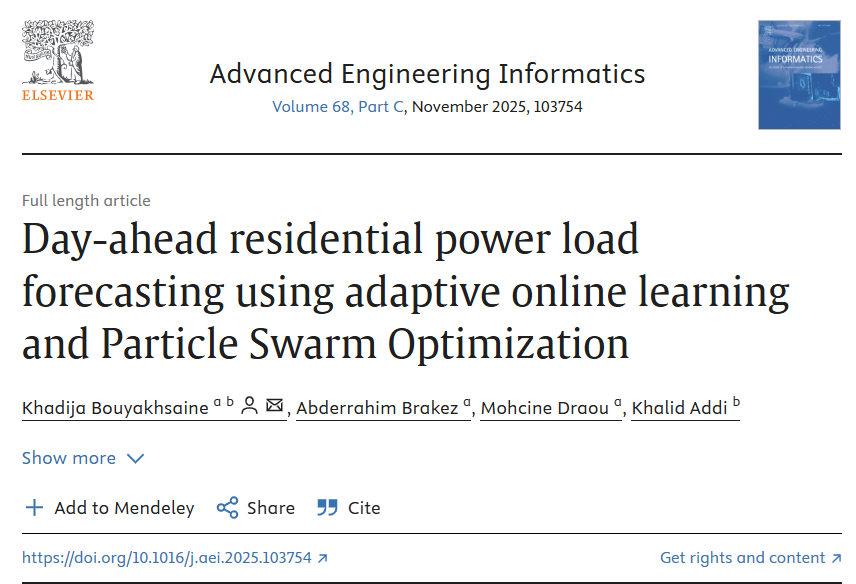
Day-ahead residential power load forecasting using adaptive online learning and Particle Swarm Optimization :
Forecasting the energy load one day in advance is essential for optimising energy management strategies in the residential building. This research presents a self-learning system based on the Light Gradient Boosting Machine (LightGBM) model in an online learning approach to estimate residential electricity consumption. The forecasting system was implemented in the Nassim Living Lab in Morocco, combining offline and online learning. Over a period of 16 months, real-time, high-resolution energy consumption data was collected. The online model operates in real-time, automating data collection, prediction, and integration with domestic energy management systems, thus enabling continuous monitoring and adaptation. The LightGBM model consistently achieved R2 scores between 80% and 90%, with PSO providing dynamic hyperparameter tuning to adjust to consumption variations.
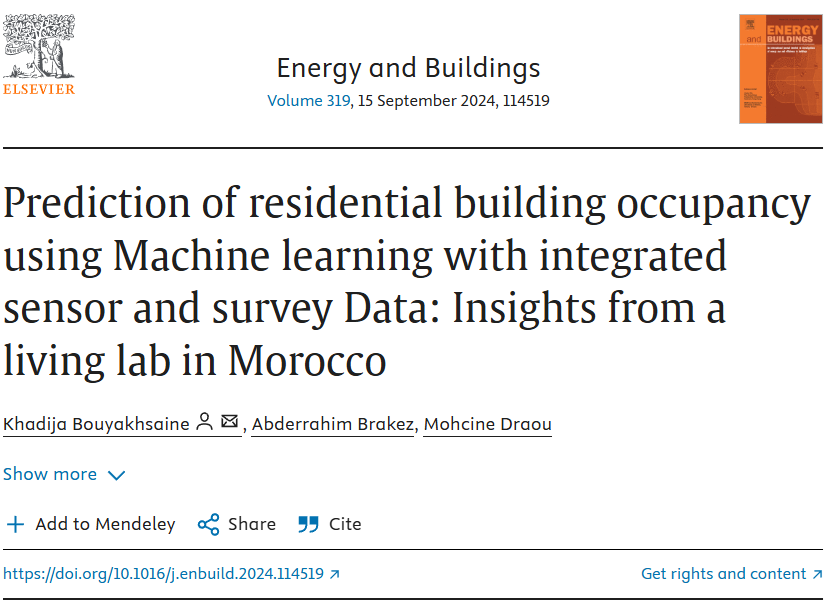
Prediction of residential building occupancy using Machine learning with integrated sensor and survey Data :
This article highlights the importance of considering building occupancy to improve energy management, balancing consumption reduction and occupant comfort. The study explores advanced occupancy modelling techniques using machine learning methods such as Random Forest, Bayesian Networks, Decision Trees, SVM, KNN, XGBoost, and RGF. These models were tested in a residential living lab using data from IoT sensors and surveys. The results show accuracy rates ranging from 70% to 95.96%, with remarkable performance from the Random Forest model in detecting occupancy trends, and from the Bayesian Network for detailed classification of occupancy types.
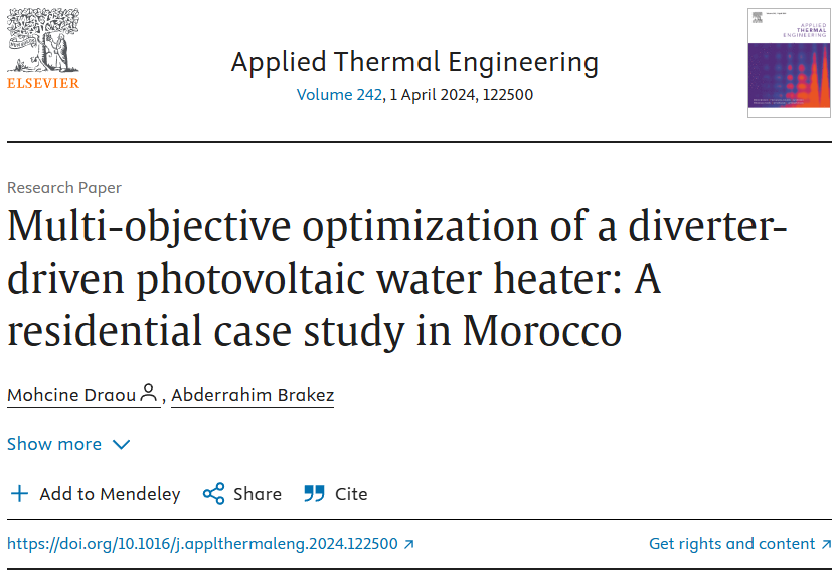
Multi-objective optimization of a diverter-driven photovoltaic water heater: A residential case study in Morocco :
This study explores the optimisation of a domestic hot water storage system coupled with a photovoltaic installation with a power diverter, in order to maximise self-consumption while maintaining water above 55 °C. A multi-objective optimisation identified an efficient configuration achieving 87% self-consumption and 2190 hours of hot water above the safety threshold. Compared to the reference system, this configuration reduces auxiliary energy by 46%, energy losses by 20%, and CO₂ emissions by 0.175 tonnes/year. These results confirm the value of optimisation approaches for designing sustainable and efficient systems at the domestic scale.
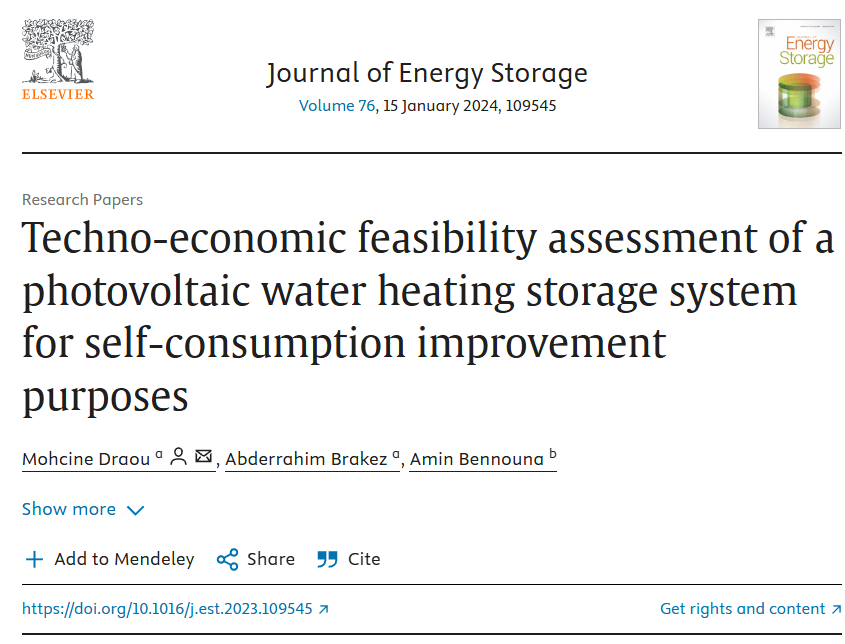
Techno-economic feasibility assessment of a photovoltaic water heating storage system for self-consumption improvement purposes :
This study assesses the technical-economic feasibility of using surplus photovoltaic energy to heat water via a storage tank, in a bioclimatic building in Marrakech. The excess energy from a 2 kWp PV system was simulated on TRNSYS based on measured data over one year. Compared to a conventional solar water heater (STWH), the photovoltaic water heater (PVWH) achieves the same thermal performance with a 52.23% improvement in the self-consumption rate. The cost of energy is 33% lower, with a payback time of 4 years for the PVWH compared to 6 years for the STWH. The net present value is also significantly higher for the PVWH solution.
Techno-economic feasibility assessment of a photovoltaic water heating storage system for self-consumption improvement purposes :
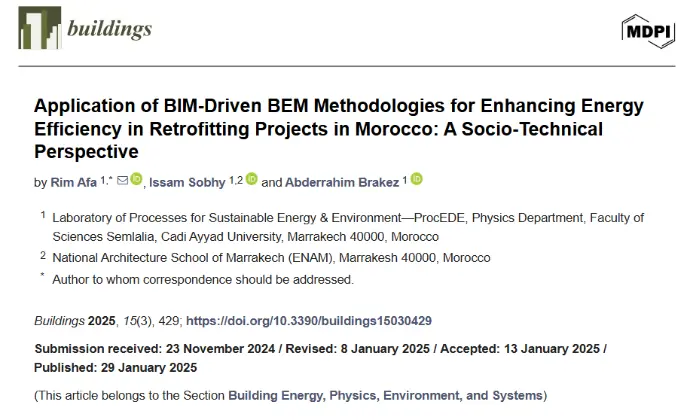
This study explores the feasibility of a BIM-based energy analysis, tailored for architects, for energy renovation in Morocco. By combining a technical approach (comparison of ArchiCAD and Revit on a real case in Marrakech) and a socio-professional survey of the local AECO market, it reveals that: ArchiCAD offers better accuracy and flexibility, while Revit better integrates standards. Despite the market potential, the persistent use of 2D drawing hinders adoption. The combination of both tools appears as a suitable solution for the varied needs of professionals. These results pave the way for a national implementation of BIM for energy renovation.
Contribution to the project ABC 21
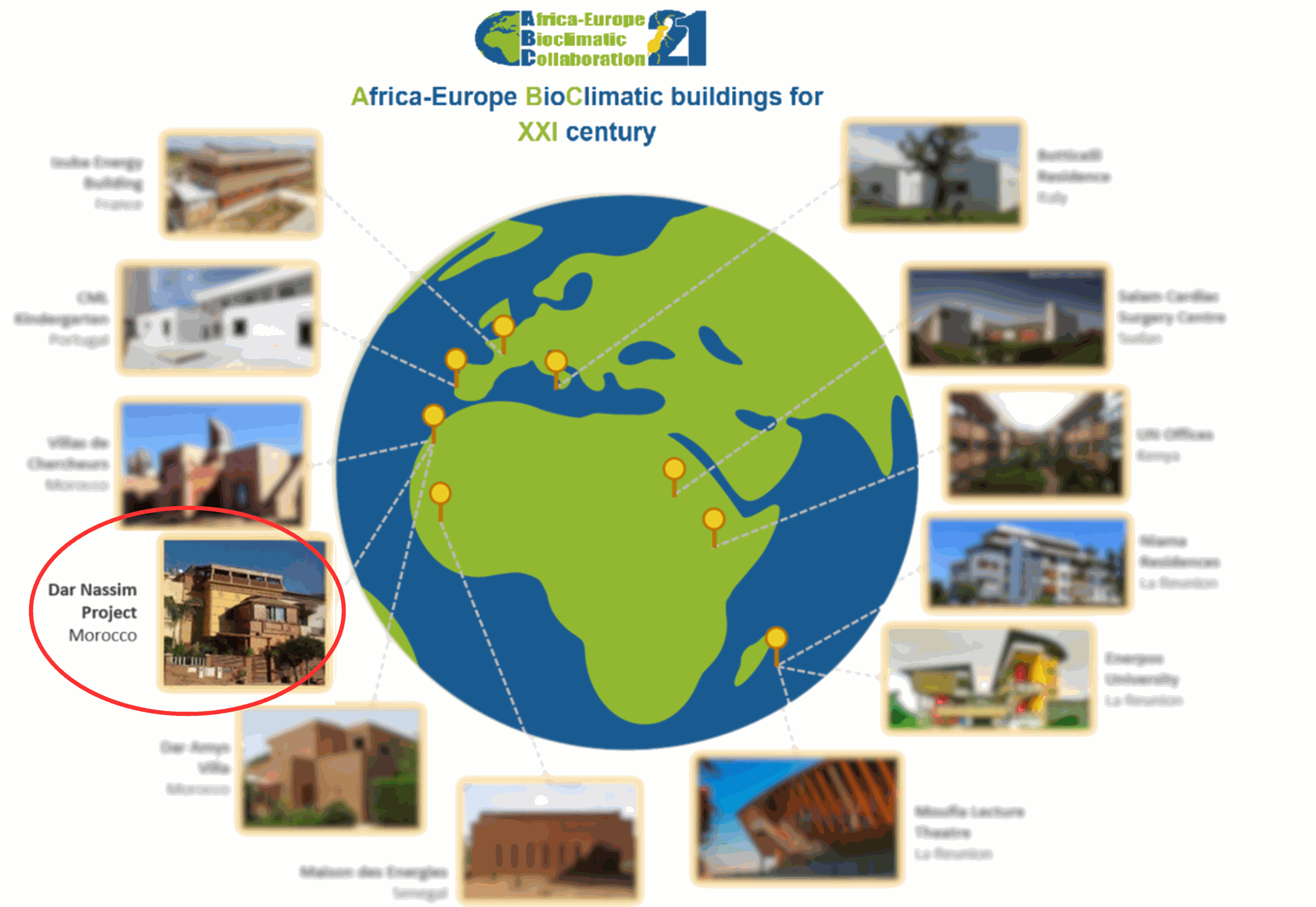
The project Nassim Living Lab located in Marrakech, makes a concrete contribution to the European project ABC 21 – Africa-Europe BioClimatic buildings for the 21st century as a demonstrator of bioclimatic solutions adapted to arid climates. It illustrates the successful integration of passive strategies, solar technologies, and digital tools into the existing habitat. Thanks to a user-centred approach and co-design, Nassim Living Lab allows for the experimentation of replicable solutions at the local and regional scale. The project thus promotes the transfer of know-how between Africa and Europe. It also strengthens academic cooperation around the energy transition in buildings.
Energy performance and economic study of a solar floor heating system for a Hammam :
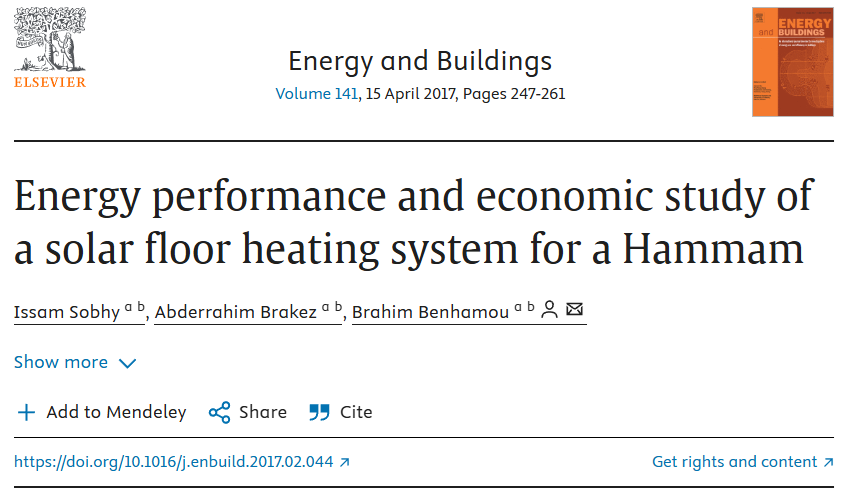
This study focuses on the analysis of the energy and economic performance of a ground solar heating system for a Hammam installed in a residential building in Marrakech. A parametric simulation phase allowed for the optimisation of its design (collectors, storage, materials, regulation). The results show that a system without thermal storage more easily reaches the desired temperature (30–37 °C), while storage ensures a more stable but lower temperature. The best configuration uses PEX tubes in a 5 cm slab, with 4 m² of solar collectors. The system allows for an annual energy saving of 72%, with a return on investment between 6 and 8 years, and a cumulative reduction of 10 tonnes of CO₂ over 15 years.
ANALYSIS FOR THERMAL BEHAVIOR AND ENERGY SAVINGS OF A SEMI-DETACHED HOUSE WITH DIFFERENT INSULATION STRATEGIES IN A HOT SEMI-ARID CLIMATE :
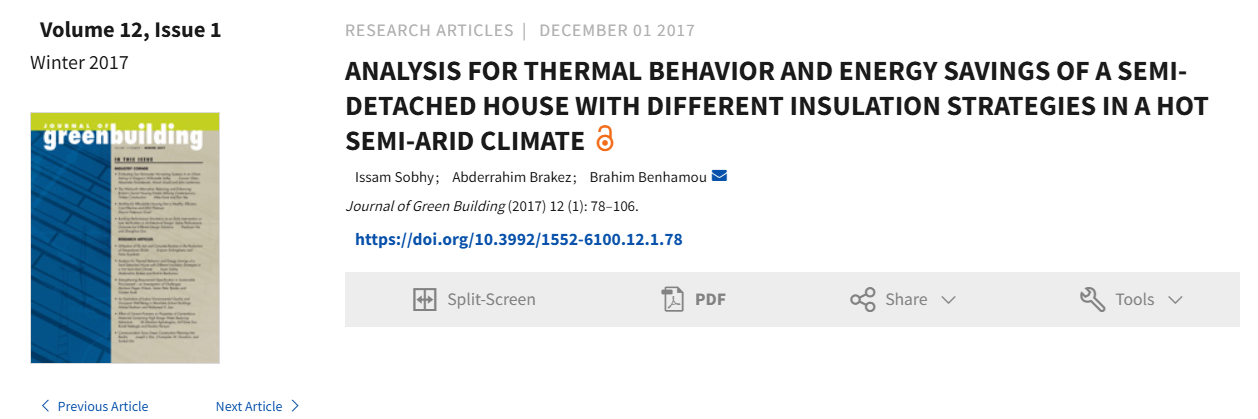
This study assesses the thermal performance and energy savings of a residential house in Marrakech, built without insulation except for the east and west walls, which are double-skinned with an air gap. Measurements show that thermal inertia mitigates fluctuations in indoor temperature, but does not guarantee thermal comfort. Simulations reveal that the double-skin walls reduce heating and cooling requirements by 13% and 5% respectively. The addition of XPS insulation to the roof improves these savings to 26% for heating and 40% for cooling.
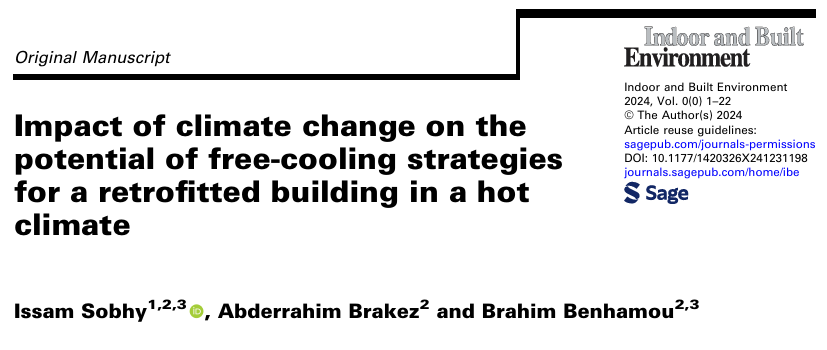
Impact of climate change on the potential of free-cooling strategies for a retrofitted building in a hot climate :
This study analyses the impact of various natural ventilation strategies, as well as smart controlled ventilation, on thermal comfort and cooling savings in a dwelling located in a hot, dry climate. The simulations show that night-time ventilation reduces the cooling load by 9% and keeps the indoor temperature below 30°C. However, its effectiveness is diminishing due to climate change, particularly in summer, when its potential falls by 25%. The RCP 2.6 scenario forecasts a slight annual increase in the overall potential for natural ventilation (+1%), whilst the RCP 8.5 scenario predicts a 4.9% decline.
ANALYSIS FOR THERMAL BEHAVIOR AND ENERGY SAVINGS OF A SEMI-DETACHED HOUSE WITH DIFFERENT INSULATION STRATEGIES IN A HOT SEMI-ARID CLIMATE :
This study assesses the thermal performance and energy savings of a residential house in Marrakech, built without insulation except for the east and west walls, which are double-skinned with an air gap. Measurements show that thermal inertia mitigates fluctuations in indoor temperature, but does not guarantee thermal comfort. Simulations reveal that the double-skin walls reduce heating and cooling requirements by 13% and 5% respectively. The addition of XPS insulation to the roof improves these savings to 26% for heating and 40% for cooling.
© Copyright 2026 - Nassim Living Lab